

In simple terms, a Fractional COO is usually the better fit when you need someone to lead execution, own accountability, and stay embedded in the business. A COO consultant or operations consultant is usually the better fit when you need specialized advice, outside perspective, or support on a narrower project.
What Is a Fractional COO?
A fractional Chief Operating Officer (COO) is an experienced executive who joins your leadership team on a part-time basis, which is often 1 to 4 hours per day. Their primary role is to manage day-to-day operations and to strategize the necessary steps to execute the vision of the company. Fractional COOs build internal systems, drive accountability, and help scale the business sustainably.
Though not full-time, a fractional COO often becomes deeply embedded in the company. They are responsible for outcomes, manage teams directly, and are often instrumental in establishing the rhythm and structure needed for long-term success.
What Is an Operations Consultant?
An operations consultant offers short-term, external support with a focus on diagnosing issues and recommending improvements. They specialize in analyzing workflows, focusing on team efficiency, and identifying opportunities to improve performance or reduce costs.
In many cases, a fractional COO is the one who brings a consultant in. The COO looks at the bigger picture, defines the priorities, and if a specific expertise gap is identified, engages a consultant to support a targeted initiative.
Consultants provide objective insights. They typically do not take ownership of implementation or manage teams. Their role is to deliver recommendations through audits, assessments, or strategic workshops. From there, the COO remains accountable for ensuring the advice is relevant, implementable, and fully integrated into the company’s operational strategy.
At-a-Glance: Fractional COO vs Operations Consultant
Before diving into the detailed differences, here is how the two roles compare side-by-side:
|
Factor |
Fractional COO |
Operations Consultant |
|
Primary role |
Leads and executes |
Diagnoses and recommends |
|
Ownership of outcomes |
Yes, accountable for results |
No, accountable for analysis |
|
Team management |
Directly leads your team |
Works around your team |
|
Engagement length |
6 to 24 months, ongoing |
4 to 16 weeks, project-based |
|
Time commitment |
1 to 4 hours per day, embedded |
Scheduled workshops and audits |
|
Typical investment |
$5,000 to $26,000 per month retainer |
$10,000 to $100,000 per project |
|
Best for |
Scaling, leadership gaps, execution bottlenecks |
Specific problems, audits, diagnostic reports |
|
What you walk away with |
A working operating system |
A set of recommendations |
|
Cultural integration |
Becomes part of your leadership team |
Remains an external advisor |
|
Follow-through |
Owns implementation |
Hands off and exits |
The distinction that matters most: a consultant gives you a playbook. A fractional COO runs the playbook.
Key Differences Between the Two
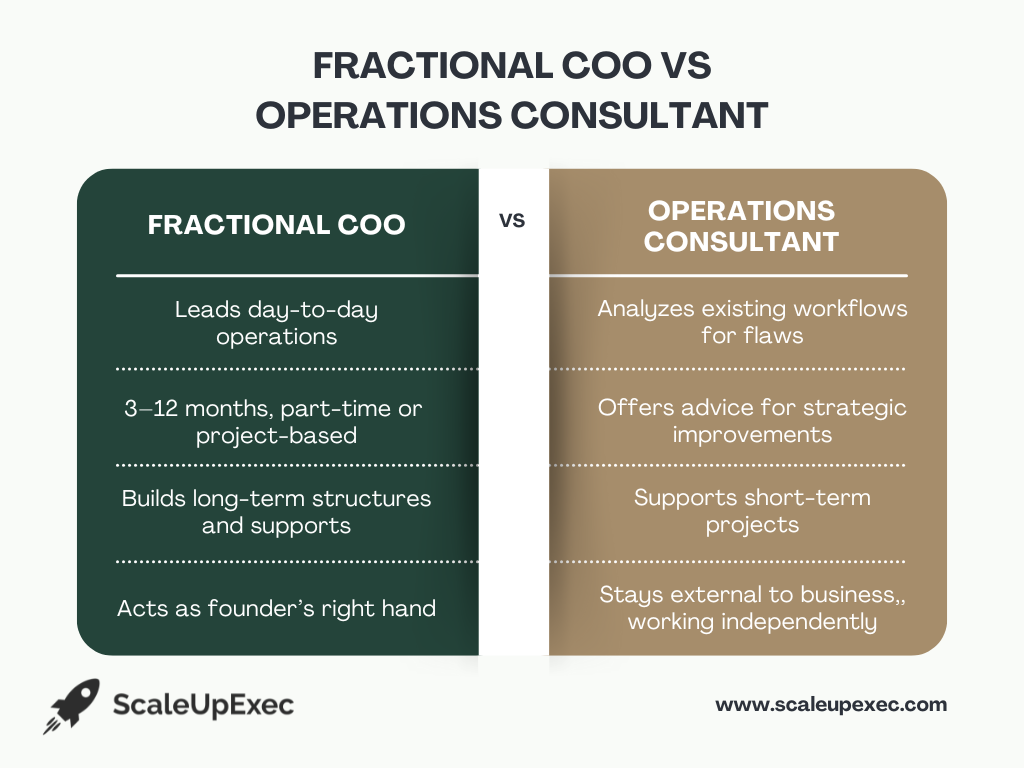
- Scope: A fractional COO owns execution and outcomes; a consultant provides strategic guidance and analysis.
- Duration: Fractional COOs engage long-term (though part-time). Consultants are brought in for defined, shorter-term projects.
- Involvement: Fractional COOs operate as part of your leadership team. Consultants remain external advisors.
- Cultural Integration: COOs must align with company culture to lead effectively. Consultants maintain independence.
When to Hire a Fractional COO
A fractional COO is ideal when your business is growing quickly and needs systems, structure, and stronger leadership to scale. They help implement processes, manage performance, and bring clarity to cross-functional teams while freeing up the founder to focus on strategy.
If your internal team lacks accountability, structure, or direction—or if you’re running day-to-day operations yourself—a fractional COO can take ownership and drive real change. This role is especially useful during transition periods or as a bridge until a full-time executive hire is warranted.
When to Bring in an Operations Consultant
If you’re facing a specific challenge, like supply chain delays, process inefficiencies, or unclear workflows, a consultant can provide an unbiased, expert assessment and recommend actionable improvements.
Consultants are also useful for operational audits, performance reviews, or implementation of new technologies. Their recommendations may lead to internal changes that require ongoing oversight, at which point a COO might step in to manage those changes long-term.
Can They Work Together?

Absolutely. Many companies use both. A consultant may diagnose problems, while a fractional COO builds the solutions into your day-to-day operations. Alternatively, a fractional COO may bring in a specialist consultant for targeted help on specific initiatives like system migrations or logistics optimization.
When used together, these roles can complement one another, as long as expectations, scope, and ownership are clearly defined.
Real-World Scenarios
- Founder Overload: A startup founder is overwhelmed managing a fast-growing team. A fractional COO steps in to take over operations and instill structure.
- Process Breakdown: A company experiences frequent delays in order fulfillment. A consultant conducts an audit and recommends changes to the supply chain and inventory process.
- Execution Gap: A startup is clear on vision but unclear on execution. A consultant defines the roadmap; a fractional COO owns the implementation.
The Decision Framework: Which One Do You Actually Need?
If you are still unsure which role fits your situation, work through these four questions in order. Each one narrows the decision until you land on the right answer.
Question 1: Do You Need Answers or Do You Need Action?
If you only need a diagnostic for a few months → Operations consultant. A fractional COO can also do diagnostics (and often better, because they have on-the-ground operational experience that adds depth to the analysis). But a fractional COO is usually a longer-term engagement. If you only need the diagnostic and nothing more, a consultant is fine.
If you want diagnostic plus the fix → Fractional COO. Whether the problem is clear or unclear, a fractional COO can diagnose it and then actually execute on the solution. If you want both analysis and action from the same person, a fractional COO is the right hire.
Question 2: Is This a One-Time Fix or an Ongoing Capability?
One-time fix → Operations consultant. Bounded problems with defined deliverables suit project-based engagements. Examples include a supply chain audit, a one-off process optimization, an ERP migration, or a compliance review.
Ongoing capability → Fractional COO. If the challenge requires leadership that adapts as your business evolves, you need someone embedded long enough to learn your people, your customers, and your systems. One-shot engagements cannot deliver that.
Question 3: Can Your Internal Team Execute Recommendations Without Senior Guidance?
Yes, your internal team can execute → Consultant works fine. The consultant delivers the playbook, and your leadership team runs it.
No, your team lacks the bandwidth, skill, or authority → Fractional COO. This is where most consultant engagements fail. A beautifully researched report sitting in a Google Drive fixes nothing. If execution is the gap, you need an operator, not an advisor.
Question 4: What Is the CEO’s Biggest Bottleneck Right Now?
“I need better information to make decisions” → Consultant. You want data, benchmarks, and outside perspective on a specific question.
“I am drowning in operations and cannot focus on growth” → Fractional COO. A fractional COO will also provide relevant analysis, but then actually take the operations off your plate and execute on the findings, so you can focus on leading the business.
A Shortcut for Most Founders
If you run a $2M to $50M business and you are the operational bottleneck, a fractional COO is almost always the right first hire. Most operational problems at this stage are execution problems, not diagnostic problems. You do not need a report. You need someone to build the systems and hold your team accountable.
Related: How to Determine If a Fractional COO Is Right for Your Organization
Cost and ROI Comparison: What You Are Actually Paying For
The raw numbers tell only part of the story. Here is how the two engagements compare in total investment and expected return.
Operations Consultant: Typical Investment
|
Project Type |
Typical Cost |
Timeline |
|
Operational audit or diagnostic |
$10,000 to $25,000 |
4 to 6 weeks |
|
Process optimization project |
$15,000 to $35,000 |
6 to 10 weeks |
|
Systems implementation |
$25,000 to $75,000 |
8 to 16 weeks |
|
Management consulting firm project |
$50,000 to $150,000+ |
3 to 6 months |
What you get: A detailed report, specific recommendations, and a transition plan. The consultant exits. What you still need: Someone to implement the recommendations. This is where most consultant engagements stall.
Fractional COO: Typical Investment
The cost of a fractional COO is driven by how many hours per day your business needs. Most fractional COOs charge between $150 and $375 per hour, depending on skillset and track record.
|
Engagement Level |
Monthly Cost |
Annual Cost |
|
1 hour/day (startups, advisory) |
$5,000 to $7,000 |
$60,000 to $84,000 |
|
2 hours/day (early growth) |
$10,000 to $13,000 |
$120,000 to $156,000 |
|
3 hours/day (growth stage) |
$16,000 to $20,000 |
$192,000 to $240,000 |
|
4 hours/day (scale-up) |
$22,000 to $26,000 |
$264,000 to $312,000 |
What you get: A part-time executive who leads, executes, and owns outcomes. Strategy, implementation, team management, accountability systems, and ongoing adjustments are all included.
An important advantage beyond cost: through the fractional model, SMBs can access top-tier operators – executives who have scaled businesses to 8- and 9-figure exits, led operations at Fortune 500 companies, or turned around 20+ businesses. This caliber of talent is rarely accessible through traditional full-time hiring at SMB compensation levels.
The Real Cost of Choosing Wrong
The most expensive mistake is hiring a consultant when you actually need a COO. You spend $25,000 on a diagnostic, receive a 40-page deck full of smart recommendations, and six months later nothing has changed because your team did not have the bandwidth to execute it. You are now $25,000 poorer and still facing the same operational chaos.
The reverse mistake is also costly: engaging a fractional COO on a long retainer for a narrow, one-time problem that a 4-week consultant engagement would have solved faster and cheaper.
Industry data suggests that embedded engagement models cost 30 to 50 percent more upfront than pure advisory work but deliver roughly 3x the implementation rate. For complex operational challenges where execution is the real constraint, that premium usually pays for itself within the first 90 days.
Related: Fractional COO Rates: 2026 Pricing Guide
Warning Signs You Are Choosing the Wrong Role
Before committing to either engagement, check for these red flags.
You Are About to Hire a Consultant, But…
- Your last two consultant engagements produced great reports that never got implemented.
- Your internal team does not have the bandwidth or authority to execute recommendations.
- The underlying problem is leadership or accountability, not a specific process gap.
- You need someone to manage people, not just advise on them.
- Every month you delay execution is costing real revenue.
If any of these apply, a consultant will deliver insights you cannot act on. A fractional COO is the better investment.
You Are About to Hire a Fractional COO, But…
- You have a specific, bounded problem (an ERP migration, a compliance review, a one-time supply chain audit).
- Your internal leadership team is strong and just needs expert guidance on a narrow question.
- You need a one-time diagnostic before committing to any direction.
- The engagement you envision ends in 4 to 8 weeks with a clear deliverable.
- You have no intention of keeping operational leadership in place long-term.
If this describes your situation, a focused consultant engagement will be faster and more cost-effective than hiring a fractional COO.
If you’re weighing both models, compare the cost of a Fractional COO before making the call.
Frequently Asked Questions: COO, CFO, and consultant – which comes first?
How much does a fractional COO cost compared to an operations consultant?
A fractional COO typically costs $5,000 to $26,000 per month depending on the number of hours per day your business needs, with most charging between $150 and $375 per hour. An operations consultant project ranges from $10,000 to $100,000 for a defined engagement of 4 to 16 weeks. Consultants can appear cheaper upfront, but the total cost often increases because you still need someone to implement the recommendations. For a full breakdown, see our 2026 Guide to Fractional COO Rates.
Can I start with a consultant and then hire a fractional COO?
Yes, and this sequence is common. Many businesses start with an operations consultant to get a diagnostic, then bring in a fractional COO to execute the recommendations. This works especially well when the leadership team wants outside perspective before committing to a direction, or when the underlying problem needs to be clearly defined before you can assess the right operational leader.
Do operations consultants manage teams?
Generally no. Operations consultants typically observe, analyze, and advise. They do not hold direct authority over your team and they do not make hiring, firing, or accountability decisions. If you need someone to lead people directly, you are looking for a fractional COO, not a consultant.
What is the difference between a fractional COO and a fractional integrator?
A fractional integrator is a specific role within certain business operating system frameworks. They typically run weekly leadership meetings, hold the team accountable to a shared vision and scorecard, and manage the operating cadence. A fractional COO performs all of these functions and more, including broader operational leadership, systems implementation, and team development. If you are already running a structured operating system and just need someone to hold the integrator seat, a fractional integrator may be enough. If you need broader operational leadership, a fractional COO is the better fit.
How long should an operations consultant engagement last?
Most operations consultant engagements run 4 to 16 weeks, depending on scope. An operational audit might take 4 to 6 weeks, while a full process redesign or systems implementation can take 3 to 4 months. Anything longer than 6 months usually means you actually need ongoing operational leadership rather than a project-based consultant.
Can you hire a fractional COO and a consultant at the same time?
Yes. In fact, a skilled fractional COO often brings in specialist consultants for targeted initiatives like logistics optimization, ERP selection, or compliance reviews. The fractional COO defines priorities and owns outcomes, while the consultant delivers specialized expertise. When expectations, scope, and ownership are clearly defined, the two roles complement each other.
Which role delivers faster ROI?
Operations consultants can deliver faster short-term wins on narrow problems, typically within 4 to 8 weeks. Fractional COOs deliver broader and more durable ROI. A skilled fractional COO will be working on quick wins in the first couple of weeks, with measurable operational improvements appearing within 60 to 90 days. The systems they build continue to generate returns long after the engagement ends. Top-tier fractional COOs who have seen and solved a wide range of challenges onboard remarkably fast and often deliver ROIs of 5-10x or more on the engagement investment.
What’s the difference between a fractional COO and a business consultant?
A consultant delivers a report and adds to your to-do list. A fractional COO gets embedded in your company, gets to know your team, and then executes. They own outcomes, not just recommendations. If something isn’t implemented, that’s the COO’s failure, not yours.
Should I hire a fractional COO or a fractional CFO first?
For most founder-led businesses under $20M, a COO first is the right call. A CFO analyzes and reports on finances. A COO diagnoses why your finances look the way they do and fixes the operational root causes. Thin margins, payroll creep, and revenue that doesn’t translate to cash are almost always operational problems before they’re financial ones. A COO will work through your P&L alongside your team structure, billing processes, and cost drivers, and make recommendations your bookkeeper or CFO can then work from.
I already have a bookkeeper and an outside accountant, do I still need a COO?
Yes, and the two don’t overlap. A bookkeeper records transactions. An accountant files and reports. Neither diagnoses why your payroll is running at 80% of revenue, or why a profitable month still leaves you cash-strapped, or which service lines are actually losing money when fully costed. A fractional COO works at the operational layer, not the accounting layer.
What if my accountability systems keep failing, does that mean I need a COO instead of a consultant?
Almost certainly yes. If you’ve already tried KPI systems, performance reviews, scorecards, and they always collapse when leadership pressure is removed, that’s not a process design problem. It’s an accountability culture problem. A consultant can redesign your KPI framework. They cannot make your team believe consequences are real. A fractional COO carries the external authority and week-over-week presence that changes the dynamic permanently.
My business needs process work, not just strategy. Does a fractional COO handle that?
Yes. SOP development, sales-to-production handoff design, team accountability frameworks, CRM buildouts. This is the core of what ScaleUpExec COOs do. Strategy without execution is advice. We do both.