

The short version
- Business turnaround services stabilize a declining company and rebuild it, typically covering cash flow stabilization, operational diagnosis, restructuring, accountability systems, and hands-on execution support.
- For founder-led SMBs, expect $10,000 to $25,000 for a diagnostic, $15,000 to $35,000 for a focused restructuring project, or $5,000 to $26,000 per month for embedded turnaround leadership.
- Most providers will not publish prices. The ranges exist, and this page states them, because you cannot plan a recovery around a cost you are not allowed to see.
- Pricing follows one of four models: fixed-fee, hourly, monthly retainer, or success fee. Each shifts risk differently between you and the provider.
- The biggest cost driver is scope, not severity. A focused engagement on the two things actually killing the business costs far less than a broad mandate, and usually works better.
- Expect measurable progress in 60 to 90 days and stabilization in 3 to 6 months for most SMB turnarounds.
Business turnaround services are professional engagements that stabilize a struggling company and rebuild it toward profitability, combining financial triage, operational restructuring, and execution support. For small and mid-sized businesses, the typical investment runs from $10,000 to $25,000 for a diagnostic up to $5,000 to $26,000 per month for embedded turnaround leadership, depending on the depth of help required.
If you have tried to find those numbers elsewhere, you will have noticed something: almost nobody publishes them. Turnaround firms describe their process, their frameworks, and their transparency, and then ask you to book a call to learn what anything costs. For a founder trying to plan a recovery with limited cash, that is exactly backwards.
This guide covers what turnaround services actually include, component by component, how the four pricing models work, what engagements cost at each level, and the questions to ask before signing anything.
What Are Business Turnaround Services?
Business turnaround services are structured engagements that reverse a company’s decline by fixing the financial and operational problems causing it, rather than treating the symptoms.
The work sits at the intersection of three disciplines. Financial triage stops the bleeding: cash visibility, collections, cost structure, and creditor management. Operational restructuring fixes how the business actually runs: processes, accountability, delivery, and the leadership rhythm. Execution support makes the changes stick, because a struggling business rarely has spare internal capacity to implement a recovery plan on top of daily survival.
Turnaround services differ from general consulting in urgency and accountability. A standard consulting engagement can afford to study a problem for a quarter. A turnaround engagement is racing the cash runway, which is why credible providers front-load a fast diagnostic and expect measurable movement within the first 60 to 90 days.
One important scope note for this guide: most SMB turnarounds are operational, not legal. If a business is facing formal insolvency, creditor litigation, or bankruptcy proceedings, it needs restructuring counsel alongside or instead of operational help. Everything below addresses the far more common situation: a fundamentally viable business that is losing money, losing control, or both.
What’s Included: The Six Core Components
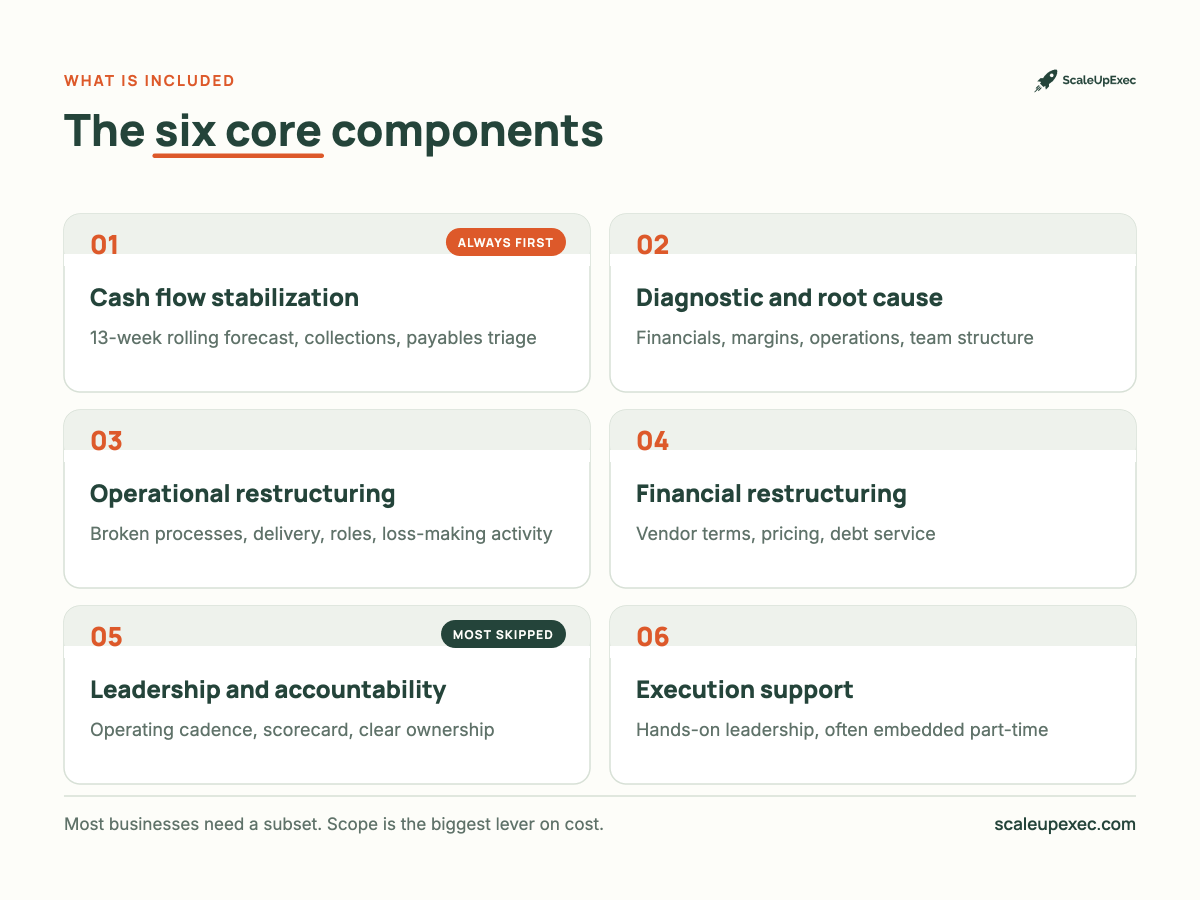
A full turnaround engagement typically covers six components. Not every business needs all six, and scoping to what you actually need is the single biggest lever on cost.
| Component | What It Involves | Why It Matters |
| Cash flow stabilization | Building a 13-week rolling cash forecast, accelerating collections, triaging payables, cutting non-essential spend | Cash buys the time everything else requires. This is always first. |
| Diagnostic and root-cause analysis | Reviewing financials, margins by product or service, operations, and team structure to find what is actually causing the decline | Most struggling businesses are treating symptoms. The diagnostic separates causes from noise. |
| Operational restructuring | Redesigning broken processes, fixing delivery problems, clarifying roles, removing loss-making activities | This is where the decline actually gets reversed |
| Financial restructuring | Renegotiating vendor terms, restructuring pricing, addressing debt service where relevant | Aligns the cost and revenue structure with reality |
| Leadership and accountability systems | Installing an operating cadence, scorecard, and clear ownership so execution stops depending on heroics | Turnarounds fail in month four when the plan exists but nobody drives it |
| Execution support | Hands-on leadership through the recovery, often embedded part-time in the leadership team | The difference between a recovery plan and a recovery |
Two components deserve emphasis for founder-led businesses. The 13-week cash forecast is the standard tool of the trade for a reason: it converts a vague sense of “cash is tight” into a specific picture of which week the problem arrives, which changes everything about decision quality. And the accountability system is the component most often skipped and most often fatal to skip, because a struggling business that returns to its old operating habits returns to its old results.
How Turnaround Pricing Works: The Four Models
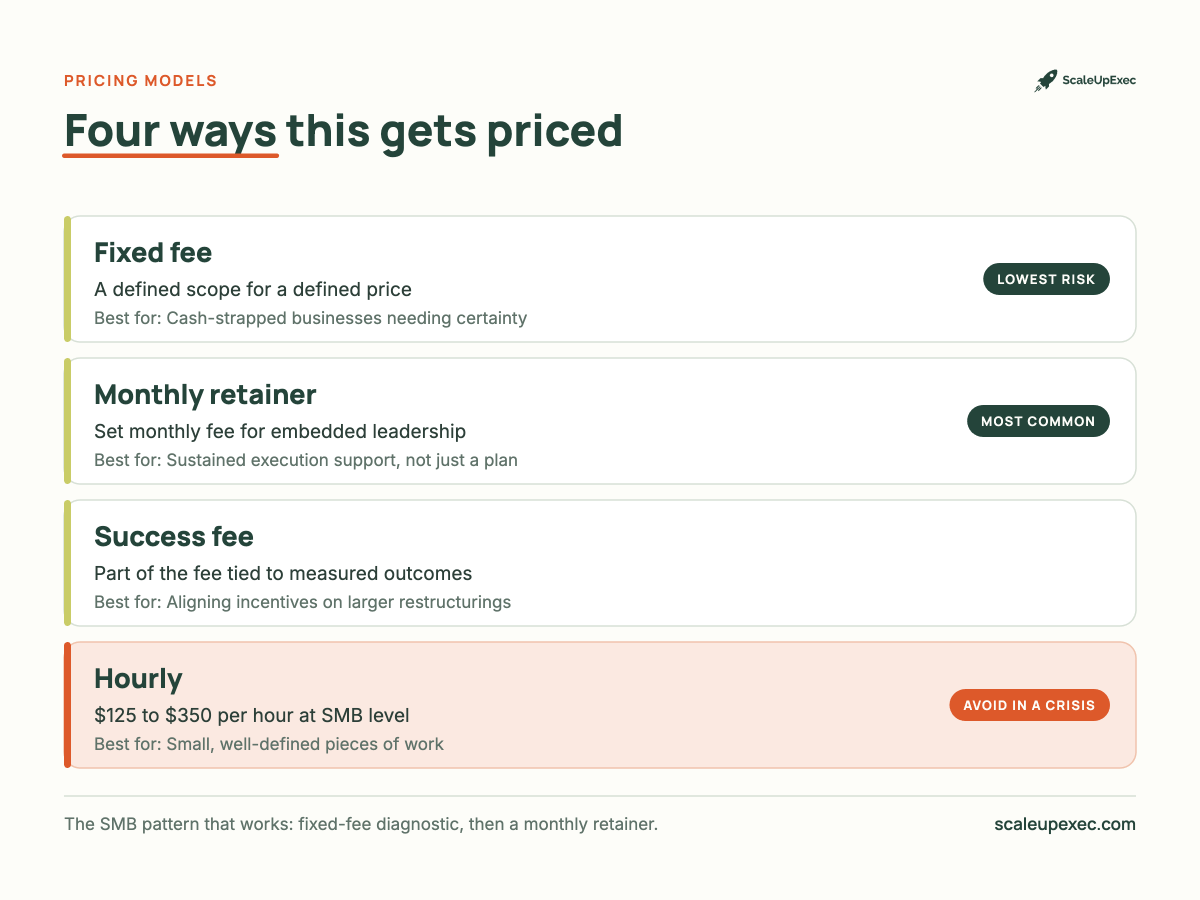
Turnaround services are priced under four models, and each one shifts risk differently between you and the provider. Understanding them is how you compare quotes that look nothing alike.
| Pricing Model | How It Works | Best For | Watch Out For |
| Fixed fee | A defined scope for a defined price, often for diagnostics and bounded projects | Cash-strapped businesses that need cost certainty | Scope creep on your side, or a scope defined so narrowly it cannot address the real problem |
| Hourly | Time billed at a professional rate, typically $125 to $350 per hour at SMB level | Small, well-defined pieces of work | Open-ended billing during a crisis, which is the worst possible combination |
| Monthly retainer | A set monthly fee for ongoing embedded leadership, scaled to the level of involvement | Businesses that need sustained execution support, not just a plan | Retainers without defined checkpoints can drift |
| Success or contingency fee | Part of the fee tied to outcomes, such as cost savings achieved or debt recovered | Aligning incentives on larger restructurings |
For most founder-led SMBs, the pattern that works is a fixed-fee diagnostic first, followed by a monthly retainer for the execution phase. That sequence caps your initial risk, forces the provider to prove diagnostic value before a longer commitment, and matches cost to the phase of work.
A pricing rule worth holding onto during a cash crisis: avoid open-ended hourly arrangements for the core turnaround work. Uncertainty in your largest discretionary expense is precisely what a struggling business cannot afford.
What Business Turnaround Services Cost
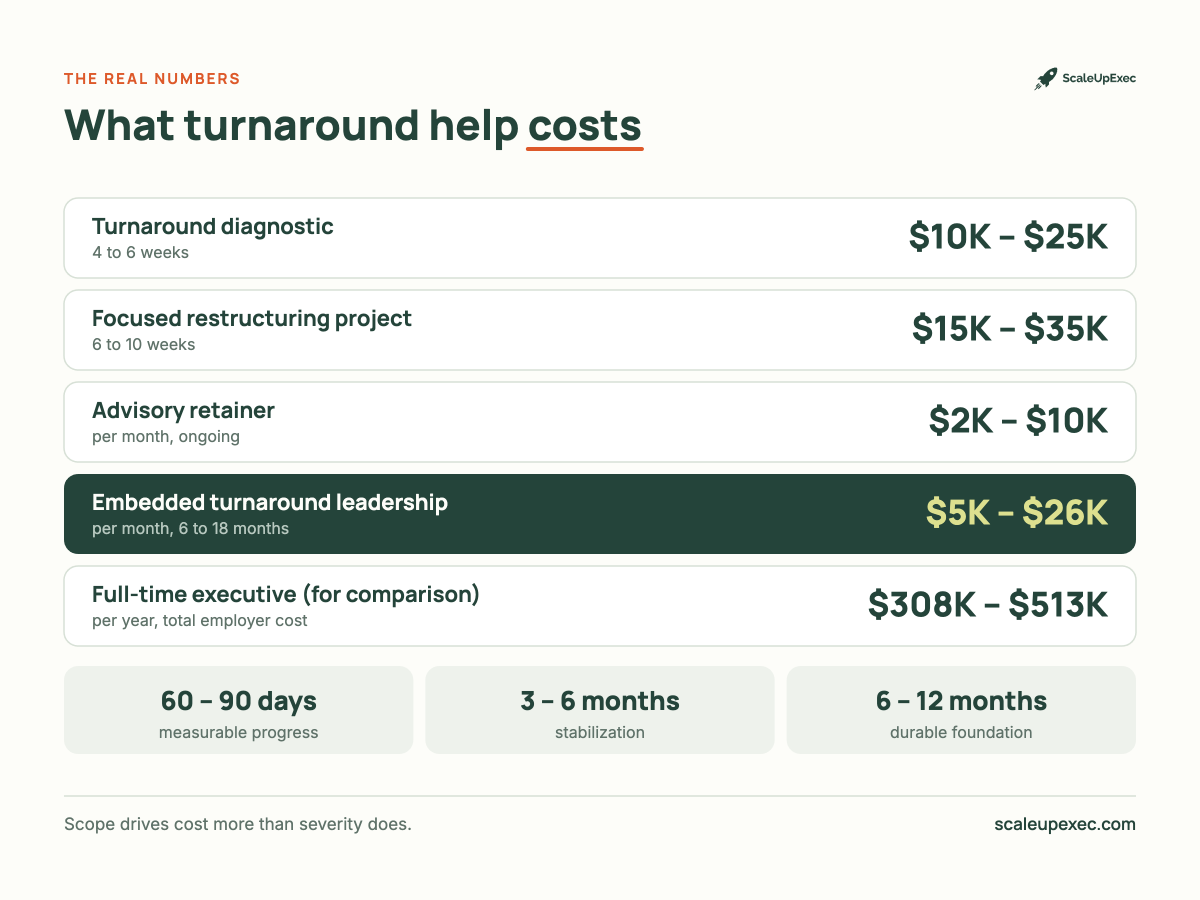
Here are the real ranges for SMB-level turnaround engagements. These are the numbers most providers make you book a call to hear.
| Engagement Type | Typical Investment | Timeline | What You Get |
| Turnaround diagnostic | $10,000 to $25,000 | 4 to 6 weeks | Full assessment of financials, operations, and team, with a prioritized recovery plan |
| Focused restructuring project | $15,000 to $35,000 | 6 to 10 weeks | Diagnosis plus implementation of a defined fix: a delivery redesign, a cost restructuring, a pricing overhaul |
| Advisory retainer | $2,000 to $10,000 per month | Ongoing | Regular guidance and accountability for a leadership team executing its own recovery |
| Embedded turnaround leadership | $5,000 to $26,000 per month | 6 to 18 months | An experienced operator part-time inside the business, owning the recovery. The monthly figure scales with the level of involvement, from light senior oversight to deep hands-on leadership during an intensive recovery. |
| Full-time turnaround executive (for comparison) | $308,000 to $513,000 per year in total employer cost | Permanent | Full-time COO-level hire, plus a 3 to 5 month search before they start |
Timeline expectations across all of these: measurable progress within 60 to 90 days, stabilization within 3 to 6 months, and a durable operating foundation within 6 to 12 months. A provider promising to fix a two-year decline in six weeks is telling you something about their honesty, not their speed.
For the detailed breakdown of embedded leadership pricing, see: Fractional COO Rates.
What Drives the Cost Up or Down
Scope drives turnaround cost more than severity does. A deeply troubled business with a focused engagement often pays less than a mildly troubled one with a vague mandate.
| Factor | Pushes Cost Down | Pushes Cost Up |
| Scope definition | Two or three named problems with clear success criteria | “Fix the business” |
| Cash visibility | Books are current and reliable | The engagement starts with reconstructing the numbers |
| Founder readiness | Leadership is prepared to make hard decisions | Every recommendation becomes a negotiation |
| Internal capacity | A capable team can execute with direction | The provider must supply execution as well as direction |
| Business complexity | One location, one core offering | Multiple entities, locations, or business lines |
| Timing | Problems addressed while cash remains | Crisis-stage work compresses timelines and premiums |
The founder-readiness row is the one to be honest with yourself about. Turnarounds involve decisions most leaders have been avoiding: restructuring the team, cutting unprofitable offerings, changing prices. A provider can bring clarity and structure, but a leadership team unwilling to act converts every dollar of turnaround spend into expensive documentation of problems everyone already knew about.
Turnaround Services vs Hiring a Turnaround Leader
The choice between buying a service and embedding a leader comes down to whether your gap is knowledge or execution.
A diagnostic or project engagement fits when the business needs to understand what is wrong and has the internal capacity to act on the answer. The engagement produces the plan, your team produces the recovery.
Embedded turnaround leadership fits when the honest answer is that nobody inside the business has the bandwidth, experience, or authority to drive the recovery, which is the most common situation in founder-led companies, because the founder is already consumed by daily survival. An embedded operator takes ownership of the recovery itself: running the cash discipline, restructuring the operations, installing the accountability rhythm, and making the daily calls a turnaround requires.
Many engagements sensibly combine the two: a fixed-fee diagnostic to establish the plan, then embedded part-time leadership through the execution phase, scaling down as the business stabilizes.
For how to evaluate the people behind either option, see: Business Turnaround Consultant. For a self-guided version of the recovery framework, see: Business Turnaround Strategy: 8 Steps to Stabilize and Rebuild.
When You Need Turnaround Services
The signal is trajectory, not a single bad quarter. If performance has been declining for two or more quarters and internal efforts have not bent the curve, outside help earns its cost.
The common triggers at SMB level: sustained losses or shrinking margins with unclear causes, cash pressure that is worsening rather than cyclical, customer or quality problems accelerating, a leadership team that keeps producing plans without producing change, and a founder who is now consumed by firefighting.
Severity matters for what kind of help fits. A business that is stuck needs less than a business that is declining, and a business in genuine cash crisis needs faster, deeper intervention than either. For a structured way to place your situation, see the severity triage in: How to Turn Around a Failing Business.
One honest note: the earlier the engagement starts, the cheaper it is, in fees and in everything else. Businesses tend to seek turnaround help six to twelve months after the point where it would have been easiest. If you are debating whether it is too early, it almost certainly is not.
Questions to Ask About Pricing Before You Sign
A credible turnaround provider can answer every one of these directly. Evasion on pricing questions from a firm you are hiring to fix your finances is its own answer.
| Question | What a Strong Answer Sounds Like |
| “What is the total cost of the diagnostic, fixed?” | A number and a timeline, not a range contingent on discovery |
| “What specifically will exist at day 90 that does not exist today?” | Named work products: the cash forecast, the prioritized plan, the operating cadence running |
| “What is your pricing model for the execution phase, and can I see it now?” | The model and the range before you commit to the diagnostic |
| “What happens to the fee if we need to pause?” | Clear terms. Cash-strapped businesses sometimes must pause, and the contract should anticipate it. |
| “What portion of your fee, if any, is tied to results?” | A straight answer either way, with “success” defined measurably if any portion is contingent |
| “What is the smallest engagement that would still help?” | A genuine answer. A provider who can only sell the full program is selling the program, not solving your problem. |
FAQs
What are business turnaround services?
Business turnaround services are structured engagements that reverse a company’s decline by stabilizing cash flow, diagnosing root causes, restructuring operations and costs, installing accountability systems, and supporting execution of the recovery. They combine financial triage with operational restructuring and hands-on leadership.
What is included in business turnaround services?
A full engagement typically includes cash flow stabilization with a 13-week rolling forecast, a diagnostic of financials and operations, operational restructuring, financial restructuring such as pricing and vendor terms, installation of leadership and accountability systems, and hands-on execution support. Most businesses need a subset rather than all six components.
How much do business turnaround services cost?
For founder-led SMBs, a turnaround diagnostic typically costs $10,000 to $25,000 over 4 to 6 weeks. A focused restructuring project runs $15,000 to $35,000. Advisory retainers run $2,000 to $10,000 per month, and embedded turnaround leadership runs $5,000 to $26,000 per month depending on the level of involvement.
How are turnaround services priced?
Under four models: fixed fee for defined scopes, hourly at typically $125 to $350 for SMB-level work, monthly retainers for embedded leadership, and success fees tied to measured outcomes. The pattern that works best for most SMBs is a fixed-fee diagnostic followed by a monthly retainer for execution.
How long does a business turnaround take?
Expect measurable progress within 60 to 90 days, stabilization within 3 to 6 months, and a durable operating foundation within 6 to 12 months. Timelines shorten with focused scope and leadership willing to make hard decisions quickly, and lengthen when either is missing.
Do turnaround services work for small businesses?
Yes. Many turnaround professionals work specifically with businesses in the $2M to $40M range, and the engagement structures scale accordingly: fixed-fee diagnostics and part-time embedded leadership exist precisely because smaller businesses need turnaround expertise without enterprise-firm pricing.
When should a business hire turnaround services?
When decline has persisted for two or more quarters despite internal efforts, when cash pressure is worsening rather than cyclical, or when leadership keeps producing plans without producing change. Earlier is cheaper: most businesses seek help six to twelve months after the point where recovery would have been easiest.
What is the difference between turnaround services and a turnaround consultant?
Turnaround services describe the engagement and its components: the diagnostic, restructuring, and execution support. A turnaround consultant is one type of provider who delivers them, typically in an advisory or project capacity. For declining businesses whose gap is execution rather than knowledge, embedded turnaround leadership often fits better than a purely advisory engagement.
Need a Straight Answer on Your Situation?
A turnaround starts with knowing exactly where the business stands and what the recovery actually requires, including what it costs.
At ScaleUpExec, we provide embedded turnaround leadership for founder-led SMBs. We work exclusively with top-tier operators, people who have scaled businesses to 8- and 9-figure exits, led operations at Fortune 500 companies, or turned around 20+ businesses. They join part-time, stabilize the cash position, restructure the operations, and drive the recovery from inside the business, taking ownership of both strategy and execution. Our clients consistently see ROIs of 5-10x or more on their investment, and our pricing is on this page and on our rates page, because a business planning a recovery deserves to see the numbers before a sales call.
If your situation calls for something lighter, a diagnostic, an advisory arrangement, or nothing yet, we will say so.
Book a Free 30-Minute Strategy Call to talk through where the business stands and what the next 90 days should look like.
Book a Free 30-Minute Strategy Call
No pressure. No obligation.
ScaleUpExec is a specialist in the fractional COO and turnaround space, with 30+ engagements and over a dozen top-tier operators on the team, each extensively vetted. That focus is reflected in our track record of 0 client churn.
Prefer to explore first? See what our clients say or learn about Fractional COO Rates.