
The short version
- “Best” depends on fit. A $3M business rebuilding its processes and a $40M business preparing to exit need different things from a firm. The strongest firms can serve both, because their operators have been through both stages. Match the firm to your situation.
- Operator caliber is the single biggest differentiator. Some firms work exclusively with operators who have scaled businesses to eight and nine figures, and often to exits. Others place whoever is available. The gap in outcomes is enormous.
- Ask about the vetting process, not the roster. Any firm can show impressive bios. Far fewer can explain what percentage of applicants they reject and why.
- Demand evidence, not adjectives. “Experienced operators” means nothing. Specific outcomes with numbers, from businesses your size, mean everything.
- The six things that actually separate strong firms: operator caliber, vetting rigor, matching process, execution ownership, the support behind each operator, and what happens when the fit is wrong.
The best fractional COO companies are separated from average ones by six things: the caliber of operators they work with, how rigorously they vet them, how carefully they match operators to businesses, whether they own execution or just advise, what support stands behind each operator, and what they do when a placement is not working. Everything else is packaging.
This is not a list of firms. Rankings of “top fractional COO companies” are usually paid placements or affiliate content, and they cannot tell you which firm fits your specific business. What is more useful is knowing what to actually look for, so you can evaluate any firm yourself.
If you are still working out what types of providers exist and what they cost, start here: Fractional COO Companies: How to Choose the Right Partner. This page assumes you have narrowed to firm-backed providers and want to tell the strong ones from the weak ones.
Why “Best” Depends on Your Situation
There is no universally best fractional COO company, because the right firm depends on your business size, your specific operational problem, and how much structure you need around the engagement. A firm that excels with early-stage founders may be wrong for a company preparing for acquisition.
Before evaluating any firm, get clear on which of these describes you:
| Your Situation | What “Best” Means for You |
| Operations are breaking under growth | A firm whose operators have scaled businesses through the same revenue band you are entering |
| The founder needs to exit daily operations | A firm with a track record of reducing founder dependence, not just improving processes, ideally with operators who have sat in the founder seat themselves, so they understand what you are going through from a first-hand perspective |
| The business is in trouble and needs stabilizing | A firm with genuine turnaround experience, not just growth-stage operators |
| Preparing for a sale or transition | A firm with operators who have been through M&A and understand what buyers scrutinize |
| One function is broken, the rest works | Possibly not a firm at all. A specialist or a solo operator may fit better. |
| You have tried outside help before and it did not stick | A firm that owns execution rather than delivering recommendations |
A firm that cannot tell you honestly whether your situation fits their strengths is showing you something important about how they operate.
The Six Things That Separate the Best Firms
Most firms look similar on their websites. These six dimensions are where the real differences show up, and where your evaluation should concentrate.
1. Operator Caliber
This is the largest single differentiator and the hardest to fake once you probe.
The fractional model exists partly because it gives smaller businesses access to operators they could never afford full time. Firms that work exclusively with top-tier operators are offering something genuinely different from firms that place competent generalists. The gap between a typical-skillset operator and someone who has scaled businesses to eight or nine figures, and often to exits, and led operations inside major companies is not incremental. It shows up in how fast they diagnose problems and how good their decisions are under pressure.
What to ask: What have your operators actually built, scaled, or turned around? Not where have they worked, but what did they own and what happened as a result?
2. Vetting Rigor
The best firms reject the overwhelming majority of operators who apply to them, and they can tell you exactly why.
Vetting is where firms diverge most and disclose least. Some firms interview extensively and accept a tiny fraction of applicants. Others function closer to a staffing agency, maintaining a broad bench and matching on availability. Both models exist under the same “fractional COO firm” label.
What to ask: How many operators have you reviewed, and how many are on your team today? What disqualifies someone? Who does the final interview?
3. Matching Process
A talented operator in the wrong business creates friction rather than progress. How a firm matches is as important as who they have.
Strong matching accounts for business stage, the specific operational gaps, the founder’s working style, and cultural fit. Weak matching accounts for availability. The difference is usually visible in the first conversation: a firm doing real matching asks far more questions than it answers.
What to ask: What factors beyond availability determine the match? Will I meet more than one candidate? What happens if the chemistry is wrong?
4. Execution Ownership
The best firms place operators who take ownership of outcomes. Weaker firms place advisors who produce recommendations and leave implementation to you.
This is the distinction that determines whether anything actually changes in your business. An operator who joins your leadership rhythm, manages your function heads, and is accountable for results is doing a fundamentally different job than someone who attends a monthly call and offers guidance.
What to ask: What will this person own versus advise on? Will they manage my team members directly? What are they accountable for?
5. Support Behind the Operator
The best firms do not send an operator in alone. They back each one with shared knowledge from across the firm and with execution support the operator can call on.
Support comes in two forms. The first is knowledge cross-pollination: operators across the firm compare notes on what is working in their engagements, so a problem your operator meets for the first time may already have been solved in another client’s business. The second is execution support: in-house resources such as a techops team that can turn the operator’s priorities into working systems, automations, and tools, without you hiring a separate vendor. An operator with both behind them moves faster than one working on individual experience and their own two hands.
What to ask: How do your operators share what they learn across engagements? What in-house support, such as techops, AI, or systems work, can my operator draw on, and is it included or billed separately?
6. What Happens When It Is Not Working
Every firm has placements that do not work. The best ones have a process for it. The weakest ones avoid the question.
Fit issues are normal and not necessarily anyone’s fault. What separates firms is whether they monitor engagement health proactively, surface problems early, and can reassign without you restarting from scratch.
What to ask: How do you know if an engagement is off track? What is the process if the fit is wrong at week six? What are the contract terms for ending early?
The Evaluation Scorecard
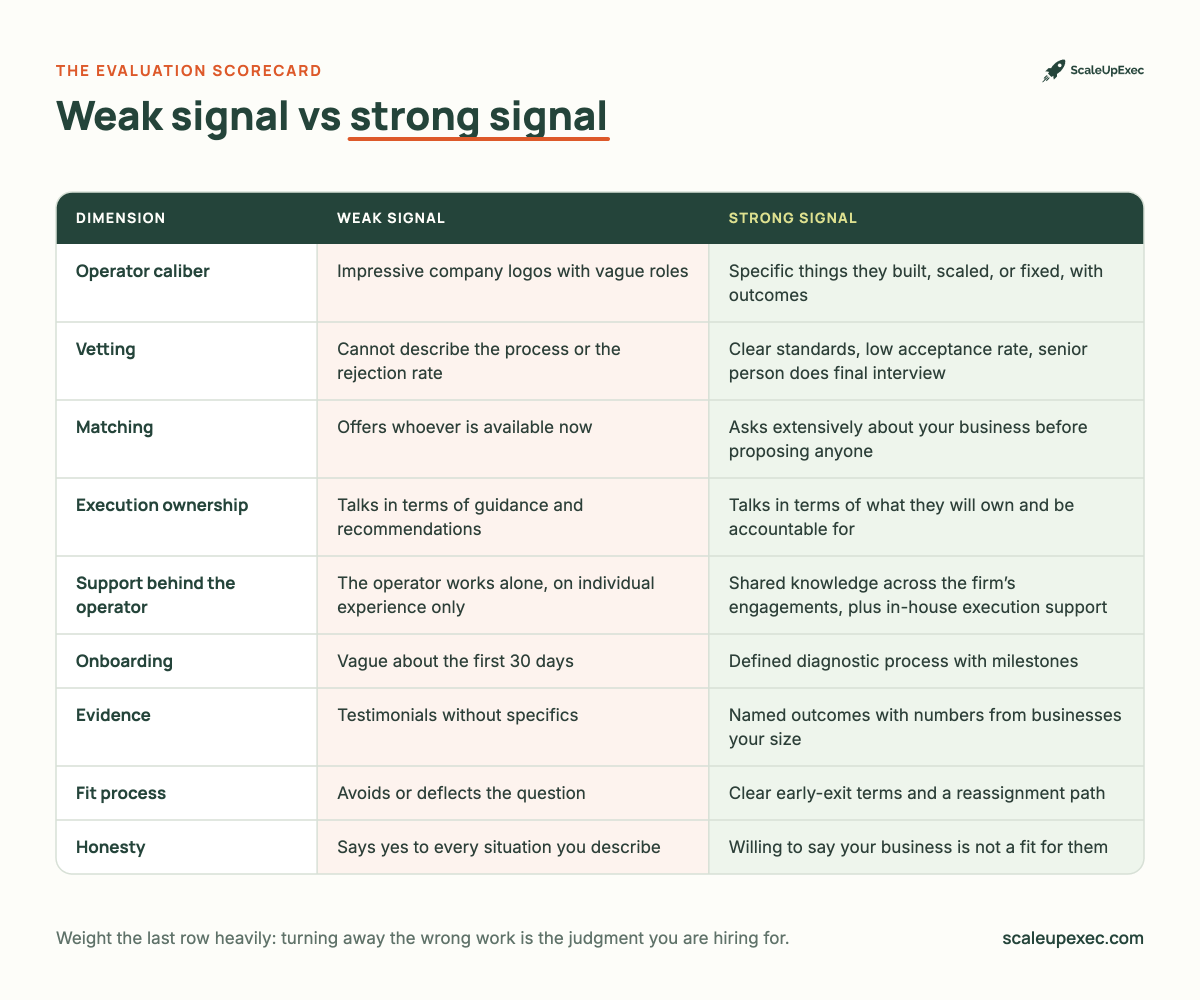
Score each firm across these dimensions before deciding. A firm that scores strongly on operator caliber but weakly on execution ownership will produce good advice and little change.
That last row is worth weighting heavily. A firm willing to turn away work that does not fit is demonstrating the judgment you are hiring them for. A firm that enthusiastically agrees it can solve every problem you describe is selling.
The Evidence to Demand
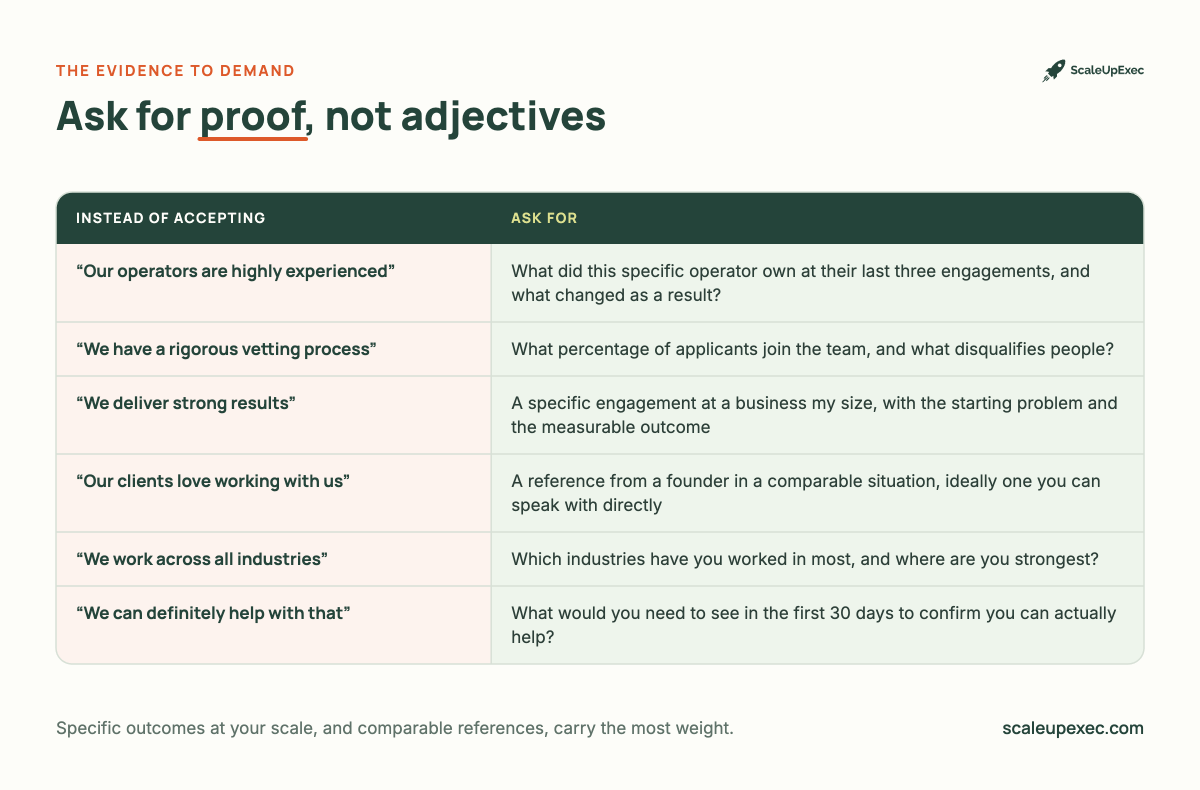
Adjectives are free. Ask for evidence that would be difficult to fabricate.
Two evidence types carry more weight than the rest. First, specific outcomes with numbers from businesses at your scale, because operational impact at $200M does not translate to $8M. Second, client retention: a firm that rarely loses clients is telling you something more meaningful than any testimonial.
You can review what ScaleUpExec clients have said about specific engagements and outcomes on our case studies.
Questions That Reveal How a Firm Actually Operates
Generic questions get rehearsed answers. These questions are harder to prepare for and reveal more.
| Question | What You Are Listening For |
| “Tell me about an engagement that did not go well and what you did about it.” | Whether they acknowledge failure at all, and whether they have a real process for it |
| “What kind of business are you not a good fit for?” | Self-awareness. A firm with no answer has not thought carefully about its own strengths. |
| “Who would you put on this and why that person specifically?” | Whether matching is genuine or whoever is free |
| “What would need to be true in my business for this to fail?” | Whether they understand the founder-side conditions for success, like transferring authority |
| “What happens after the engagement ends?” | Whether they build durable systems or create dependence |
| “How do you measure whether this is working?” | Whether success is defined concretely or left comfortably vague |
Pay attention to whether the firm asks you difficult questions in return. A firm that spends the first call diagnosing your business rather than presenting its own credentials is behaving the way you would want its operators to behave inside your company.
Warning Signs Worth Taking Seriously
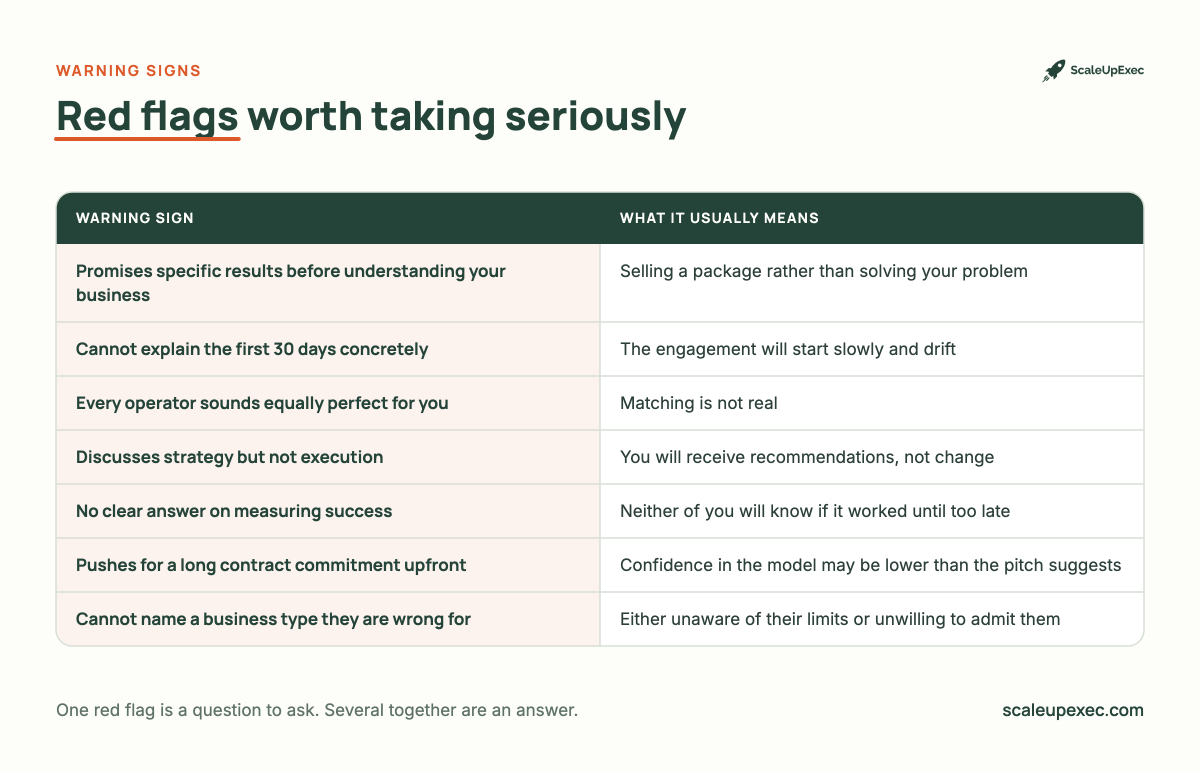
Some signals reliably indicate a firm that will disappoint, regardless of how strong the pitch is.
Firm, Solo Operator, or Neither?
The best firm in the world is the wrong answer if your business does not need a firm. Before evaluating providers, confirm the model fits.
A firm-backed engagement makes most sense when the problems span multiple functions, when you want structured matching and engagement support, or when the cost of a wrong hire is high enough to justify paying for that structure.
A solo operator can be the better answer when the scope is narrow and clearly defined, when you have the experience to evaluate and manage an operator directly, and when budget flexibility matters more than support infrastructure.
Neither may be right if what you actually need is a specific project completed, a functional hire, or systems built rather than a person added. For the full comparison of firm versus solo models, see: Fractional COO Firms vs Solo Fractional COO.
For what an operator would own day to day, see: Fractional COO Responsibilities. For what engagements cost across levels, see: Fractional COO Rates.
FAQs
What makes a fractional COO company one of the best?
Six things separate strong firms from average ones: the caliber of operators they work with, how rigorously they vet them, how carefully they match operators to businesses, whether their operators own execution or only advise, what support stands behind each operator, such as shared knowledge across engagements and in-house execution help, and whether they have a real process for handling a placement that is not working.
How do I choose the best fractional COO company for my business?
Start by defining your situation, since what you need from a firm when stabilizing operations differs from what you need when preparing to exit. Then evaluate candidate firms on operator caliber, vetting rigor, matching process, execution ownership, the support behind each operator, and evidence of outcomes at businesses your size.
Are “top fractional COO companies” lists reliable?
Usually not. Most ranked lists are paid placements or affiliate content, and even honest ones cannot account for your specific situation. Evaluation criteria are more useful than rankings, because they let you assess any firm against what actually matters for your business.
What should I ask a fractional COO company before hiring?
Ask what their operators have specifically built or turned around, what percentage of applicants they accept, how they match beyond availability, what the operator will own versus advise on, what support the operator can draw on from the firm, what happens if the fit is wrong, and what kind of business they are not right for.
How can I tell if a fractional COO firm is high quality?
Look for specific outcomes with numbers rather than adjectives, a vetting process they can describe in detail, matching that involves real questions about your business, real support behind each operator, willingness to say they are not a fit for certain situations, and a clear answer on what happens when a placement is not working.
What is the difference between a fractional COO firm and a staffing agency?
A strong fractional COO firm vets heavily, matches deliberately, supports its operators, and stays involved in the engagement. A staffing model maintains a broad bench and matches primarily on availability. Both may describe themselves the same way, which is why asking about vetting standards and rejection rates matters.
Should I choose a firm or a solo fractional COO?
A firm generally fits better when problems are cross-functional, when you want structured matching and support, or when a wrong hire would be costly. A solo operator can work well for narrow, clearly defined scopes where you can evaluate and manage the relationship yourself.
How much do the best fractional COO companies cost?
Firm-backed engagements typically run $5,000 to $26,000 per month depending on hours, with most operators charging between $150 and $375 per hour. The highest-caliber firms sit at the upper end of that range, though the relevant comparison is impact rather than rate. See Fractional COO Rates for a full breakdown.
Evaluating Your Options?
The most useful thing you can do before hiring any fractional COO firm is get specific about your own situation, because that is what determines which firm is genuinely the best fit.
Book a Free 30-Minute Strategy Call to talk through your situation and get an honest read on whether a fractional COO firm is the right move.
Book a Free 30-Minute Strategy Call
No pressure. No obligation.