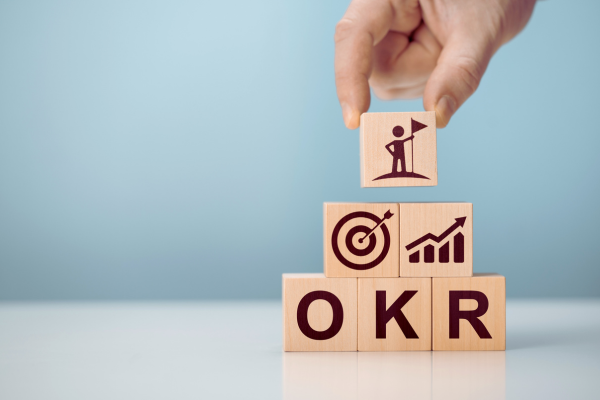

An OKR has two parts: the Objective and the Key Results. The Objective is what you want to achieve. The Key Results are how you measure whether you achieved it. Together, they create a complete goal that is both inspiring and measurable.
Two Parts
This guide breaks down each part with clear examples so you can understand the structure and start writing your own OKRs with confidence.
Part 1: The Objective
The Objective is the first part of an OKR. It describes what you want to achieve in clear, motivating language.
What Makes a Good Objective
Qualitative, not quantitative. The Objective should be expressed in words, not numbers. Save the metrics for Key Results.
Inspiring. A good Objective makes people want to achieve it. It should feel meaningful and worth pursuing.
Ambitious. The Objective should stretch the team beyond comfortable limits. It should describe a destination worth reaching.
Clear. Anyone reading the Objective should understand what success looks like. Avoid vague language or corporate jargon.
Memorable. The team should be able to recall the Objective without checking a document. If it is too long or complex, simplify it.
The Objective Answers One Question
“Where do we want to go?”
Think of the Objective as a destination on a map. It tells everyone which direction to head. It does not specify the exact route or how long the journey will take. Those details come from the Key Results.
Examples of Strong Objectives
- “Become the most trusted brand in our category”
- “Build a world-class customer success organization”
- “Launch a product that customers love and recommend”
- “Create a workplace where top talent thrives”
- “Establish our company as the thought leader in operational excellence”
Strong Objectives paint a picture of success. Weak Objectives are either too vague to provide direction or too specific to inspire.
Part 2: Key Results
Key Results are the second part of an OKR. They define how you will measure success in achieving your Objective.
What Makes Good Key Results
Quantitative. Every Key Result should include specific numbers. “Increase satisfaction” is not a Key Result. “Increase NPS from 32 to 50” is.
Specific. Key Results should be precise enough that anyone can determine whether they were achieved. There should be no debate about the outcome.
Outcome-focused. Key Results measure results, not activities. “Send 100 emails” is an activity. “Achieve 30% email response rate” is an outcome.
Time-bound. Key Results have a deadline, usually implied by the OKR cycle (typically quarterly).
Challenging but possible. Good Key Results stretch the team without being impossible. Aim for about 70% confidence you can achieve them.
Key Results Answer One Question
“How will we know we got there?”
If the Objective is the destination, Key Results are the signposts that tell you whether you have arrived. They remove ambiguity by defining success in measurable terms.
The Key Result Formula
Use this structure for every Key Result:
[Metric] from [baseline] to [target]
Examples:
- “Increase customer retention from 80% to 92%”
- “Reduce response time from 24 hours to 4 hours”
- “Grow monthly active users from 10,000 to 25,000”
Including the baseline (where you start) makes the target meaningful. “Achieve 92% retention” means little without knowing you currently have 80%.
Examples of Strong Key Results
- “Increase NPS score from 32 to 50”
- “Reduce customer churn from 5% to 2%”
- “Grow revenue from $100K to $150K monthly”
- “Improve conversion rate from 2.1% to 3.5%”
- “Decrease average support ticket resolution time from 48 hours to 12 hours”
Strong Key Results are specific and measurable. Weak Key Results are vague or describe activities instead of outcomes.
How the Two Parts Work Together

The Objective and Key Results form a complete unit. Neither part works well alone.
An Objective without Key Results is just a wish. It provides direction but no way to measure progress or know when you have succeeded.
Key Results without an Objective are just metrics. They provide measurement but no context for why those metrics matter or what larger goal they serve.
The OKR Formula
The relationship between the two parts follows this formula:
“I will [OBJECTIVE] as measured by [KEY RESULTS]”
Example:
“I will build a world-class customer success organization as measured by:
- Increasing customer retention from 85% to 95%
- Improving NPS from 32 to 50
- Reducing time-to-value from 30 days to 14 days”
The Objective provides the inspiring direction. The Key Results provide the measurable proof of achievement.
The Alignment Test
Before finalizing any OKR, ask this question:
“If I achieve all my Key Results, will I have achieved my Objective?”
If the answer is yes, your OKR is well-structured. If the answer is no, your Key Results do not fully capture what success looks like. Add or revise Key Results until they align with the Objective.
Complete OKR Examples
Here are five complete OKRs with annotations explaining each part.
Example 1: Executive Team
Objective: Achieve product-market fit in the enterprise segment
This Objective is clear and ambitious. It describes a specific achievement (product-market fit) in a specific context (enterprise segment).
Key Results:
- KR1: Close 15 enterprise deals (up from 3 last quarter)
- KR2: Achieve $500K ARR from enterprise customers
- KR3: Attain 90% retention rate in enterprise cohort
- KR4: Reach NPS of 50+ from enterprise customers
Each Key Result is measurable with clear baselines and targets. Together, they define what product-market fit looks like in practice.
Example 2: Sales Team
Objective: Build a repeatable sales engine that consistently exceeds targets
This Objective paints a picture of a healthy, predictable sales organization. It is inspiring without being metric-specific.
Key Results:
- KR1: Achieve 110% of quarterly quota ($1.5M total)
- KR2: Increase win rate from 20% to 30%
- KR3: Shorten average sales cycle from 60 days to 40 days
These Key Results measure the outcomes that indicate a strong sales engine: hitting targets, winning more often, and closing faster.
Example 3: Marketing Team
Objective: Establish our brand as the go-to resource for operations leaders
This Objective describes a positioning goal. It is qualitative and inspiring.
Key Results:
- KR1: Grow organic website traffic from 10,000 to 30,000 monthly visitors
- KR2: Increase email subscribers from 2,000 to 8,000
Each Key Result measures an outcome that would indicate the brand is becoming a trusted resource.
Example 4: Product Team
Objective: Deliver a product experience that customers love
Simple, clear, and focused on customer value. This Objective gives the team a north star.
Key Results:
- KR1: Increase product NPS from 28 to 45
- KR2: Reduce customer-reported bugs from 40 to 10 per month
- KR3: Achieve 50% adoption of new features within 30 days of launch
These Key Results measure customer satisfaction, product quality, and engagement with new capabilities.
Example 5: Individual Contributor
Objective: Become the team expert on customer onboarding
This Objective is personal and career-focused. It describes a clear professional achievement.
Key Results:
- KR1: Reduce average onboarding time from 14 days to 7 days
- KR2: Achieve 95% satisfaction score from onboarded customers
- KR3: Create 3 reusable onboarding templates adopted by the team
Each Key Result measures a concrete outcome that would demonstrate expertise in onboarding.
Objectives vs. Key Results: Comparison Table
| Aspect | Objective | Key Results |
| Type | Qualitative | Quantitative |
| Question answered | “What do we want to achieve?” | “How will we measure success?” |
| Format | Words and language | Numbers and metrics |
| Quantity per OKR | 1 | 3 to 5 |
| Tone | Inspiring and ambitious | Specific and measurable |
| Examples | “Become market leader” | “Increase market share from 15% to 30%” |
| Purpose | Provides direction | Provides measurement |
The Structure Checklist
Use this checklist to verify your OKR is properly structured:
For your Objective:
- [ ] Is it qualitative (no numbers)?
- [ ] Is it inspiring and motivating?
- [ ] Is it clear and easy to understand?
- [ ] Can the team remember it?
For your Key Results:
- [ ] Does each one include a specific number?
- [ ] Is there a baseline (where you are now)?
- [ ] Is there a target (where you want to be)?
- [ ] Does each one measure an outcome, not an activity?
- [ ] Do you have 3 to 5 Key Results?
For the complete OKR:
- [ ] If you achieve all Key Results, will you achieve the Objective?
- [ ] Is the overall OKR ambitious but achievable?
Start Building Your OKRs
Now you understand the two parts of an OKR. The Objective provides direction. The Key Results provide measurement. Together, they create goals that are both inspiring and accountable.
Try writing one OKR now. Start with an Objective that describes where you want to go. Add three Key Results that define how you will know you got there. Run it through the checklist. Then refine until it feels right.
The framework is simple. The power comes from applying it consistently.
Scaling a business is hard, and you don’t have to figure it out alone. ScaleUpExec has helped dozens of companies implement OKRs and overcome their most difficult operational challenges. Whether you have specific questions or just want to explore your options, we’re here to help. Let’s connect.