
The short version
- Outsourced COO services give a business senior operational leadership without hiring a full-time executive. An experienced operator works with your company on a part-time, ongoing basis.
- “Outsourced COO” and “fractional COO” are the same service under different names. The market has not settled on one term, but the work is identical.
- One distinction matters when evaluating providers: are you getting a named senior operator who joins your leadership team, or an external team handling operational tasks? Those are different services.
- Typical cost is $5,000 to $26,000 per month depending on the level of involvement, against $308,000 to $513,000 per year in total employer cost for a full-time COO.
- The model fits businesses roughly $2M to $40M in revenue that have real operational complexity but cannot justify a permanent executive.
Outsourced COO services provide a business with an experienced operations executive on a part-time, ongoing basis, delivering senior operational leadership without the cost of a full-time hire. The operator joins your leadership team, takes ownership of execution and accountability, and works the hours the business actually needs.
If that sounds like a fractional COO, that is because it is. The two terms describe the same service. “Outsourced” is simply the label some founders reach for first, borrowed from how businesses describe external accounting or IT. The work underneath is identical.
This guide covers what outsourced COO services actually include, the one distinction between providers that genuinely matters, what the service costs, when it makes sense, and when it does not.
What Are Outsourced COO Services?
Outsourced COO services mean engaging a senior operations executive from outside your company to lead your operations part-time, rather than hiring one as a full-time employee.
The model exists because of a structural gap in growing businesses. Somewhere between roughly $2M and $40M in revenue, most founder-led companies develop genuine operational complexity: cross-functional problems, inconsistent execution, and a founder buried in daily decisions. At the same time, most of them cannot justify a permanent executive at $300,000 or more per year, and often do not need full-time executive attention anyway.
An outsourced COO resolves that gap. You get the judgment and leadership of an experienced operator, scaled to the hours your business actually needs.
The defining features:
- Part-time but ongoing. A set number of hours over months or years, not a short project.
- Embedded, not external. The operator attends your leadership meetings, manages function heads where appropriate, and works inside your business rather than advising from outside.
- Accountable for outcomes. They own operational results, not recommendations.
- Contracted, not employed. The engagement runs on a monthly retainer with rolling terms, which is where the “outsourced” label comes from.
Outsourced COO vs Fractional COO: Same Service, Different Name
There is no meaningful difference between an outsourced COO and a fractional COO. The terms describe the same engagement, and providers across the market use them interchangeably.
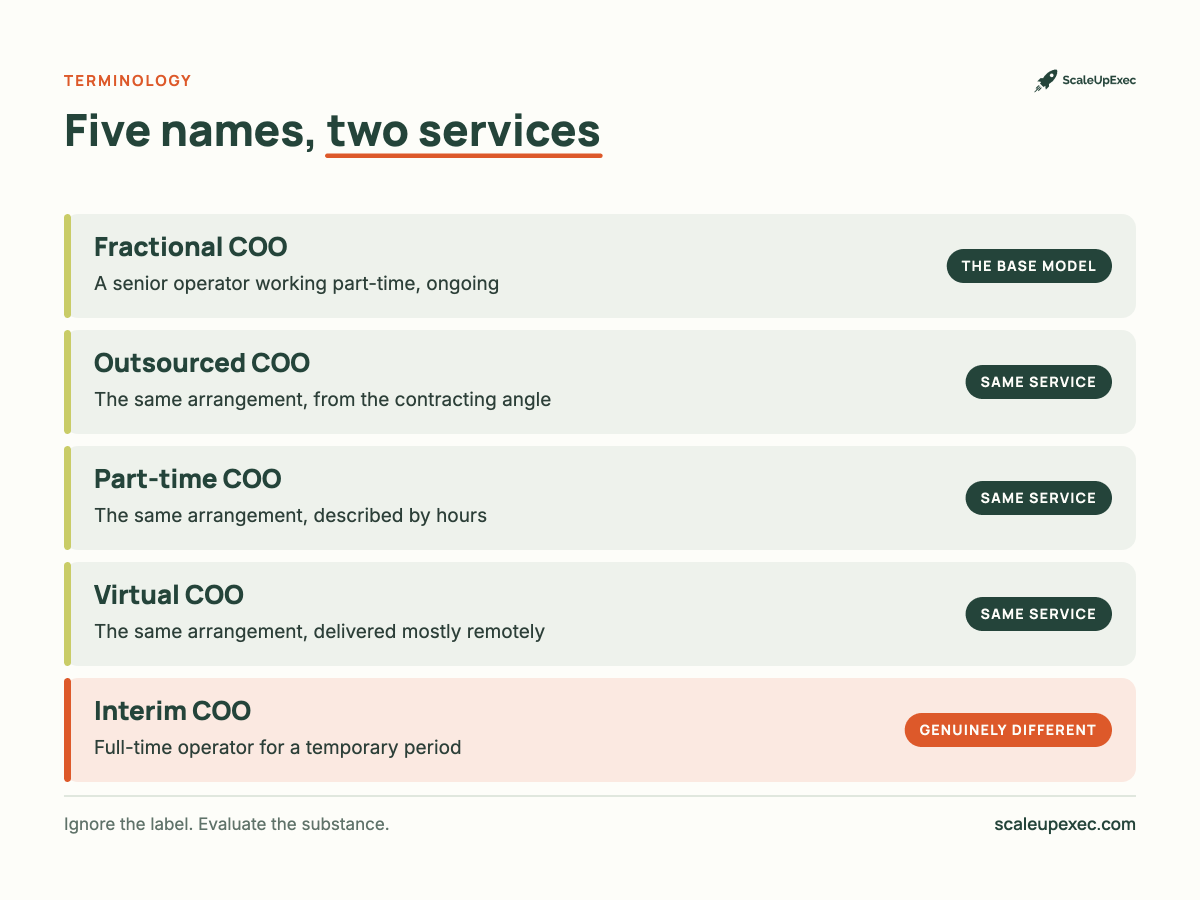
The vocabulary in this market has not standardized, which creates unnecessary confusion for founders comparing options. Here is how the common terms map:
| Term | What It Actually Means | Distinct Service? |
| Fractional COO | A senior operator working part-time, ongoing | The base model |
| Outsourced COO | The same arrangement, described from the contracting angle | No, same service |
| Part-time COO | The same arrangement, described by hours | No, same service |
| Interim COO | A full-time operator for a temporary period, usually covering a gap | Yes, genuinely different |
| Virtual COO | The same fractional arrangement, delivered mostly remotely | No, same service with a delivery detail |
The one genuinely different model in that table is interim, which is full-time and temporary rather than part-time and ongoing. If your situation is a departure to cover or a transition with an end date, that is a different decision.
For everything else, the practical advice is to ignore the label and evaluate the substance: who you get, how many hours, what they own, and what happens if it does not work.
The One Distinction That Actually Matters
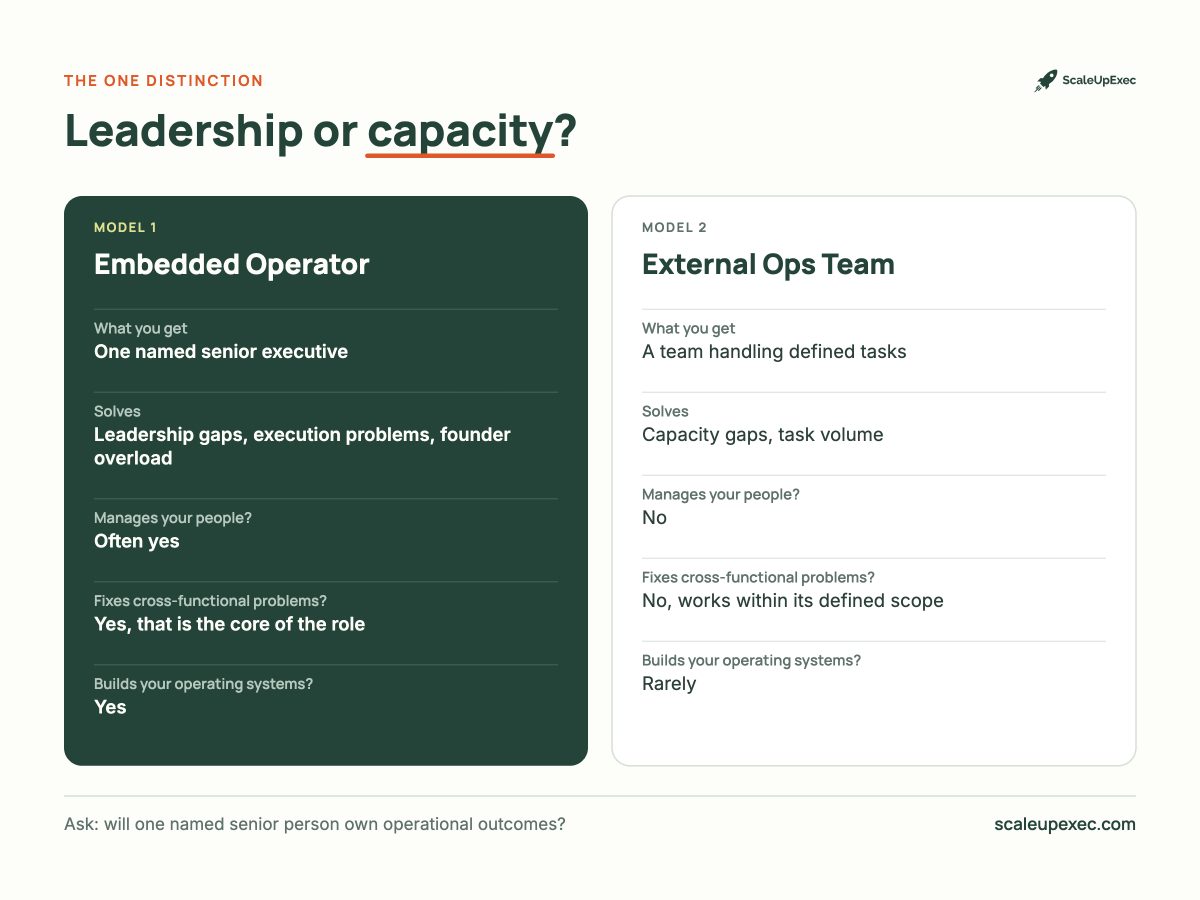
When a provider offers outsourced COO services, they mean one of two things, and the difference determines whether you are buying leadership or capacity. Ask which one before anything else.
Model 1: A named senior operator joins your leadership team. One experienced executive works with your business part-time. They attend your leadership meetings, build your operating rhythm, manage your function heads, and are personally accountable for operational outcomes. This is operational leadership, and it is what most founders searching for an outsourced COO actually need.
Model 2: An external team handles operational functions. A provider’s team takes over specific operational work: order processing, reporting, vendor management, administrative operations. Work gets done by people outside your company. This is operational capacity, and it can be genuinely valuable, but it will not fix problems that require someone with authority inside your business.
| Model 1: Embedded Operator | Model 2: External Ops Team | |
| What you get | One named senior executive | A team handling defined tasks |
| Solves | Leadership gaps, execution problems, founder overload | Capacity gaps, task volume |
| Manages your people? | Often yes | No |
| Fixes cross-functional problems? | Yes, that is the core of the role | No, works within its defined scope |
| Builds your operating systems? | Yes | Rarely |
The failure mode to avoid: hiring Model 2 when your problem needs Model 1. If your issue is that execution is inconsistent, departments are misaligned, and everything routes through you, an external task team will not touch any of it. The question that resolves it in one sentence: will one named senior person join my leadership team and own operational outcomes?
What Outsourced COO Services Include
A typical engagement covers operational leadership across five areas: the operating rhythm, execution management, team accountability, systems and reporting, and reducing founder dependence.
| Area | What the Operator Does |
| Operating rhythm | Builds and runs the meeting cadence, priorities structure, and review discipline the business runs on |
| Execution management | Owns follow-through on the company’s priorities, so initiatives finish instead of drifting |
| Team accountability | Manages function heads, clarifies ownership, and holds the team to commitments |
| Systems and reporting | Installs the scorecard, KPI reporting, and process documentation that give leadership visibility |
| Founder leverage | Absorbs the operational decisions currently routing through the founder, so the founder can return to strategy, sales, or whatever only they can do |
The specific scope varies by business and is defined at the start of the engagement. Some operators also take ownership of specific functions such as delivery or supply chain, depending on where the business’s problems sit.
For the complete breakdown of the role, see: Fractional COO Responsibilities.
What Outsourced COO Services Cost
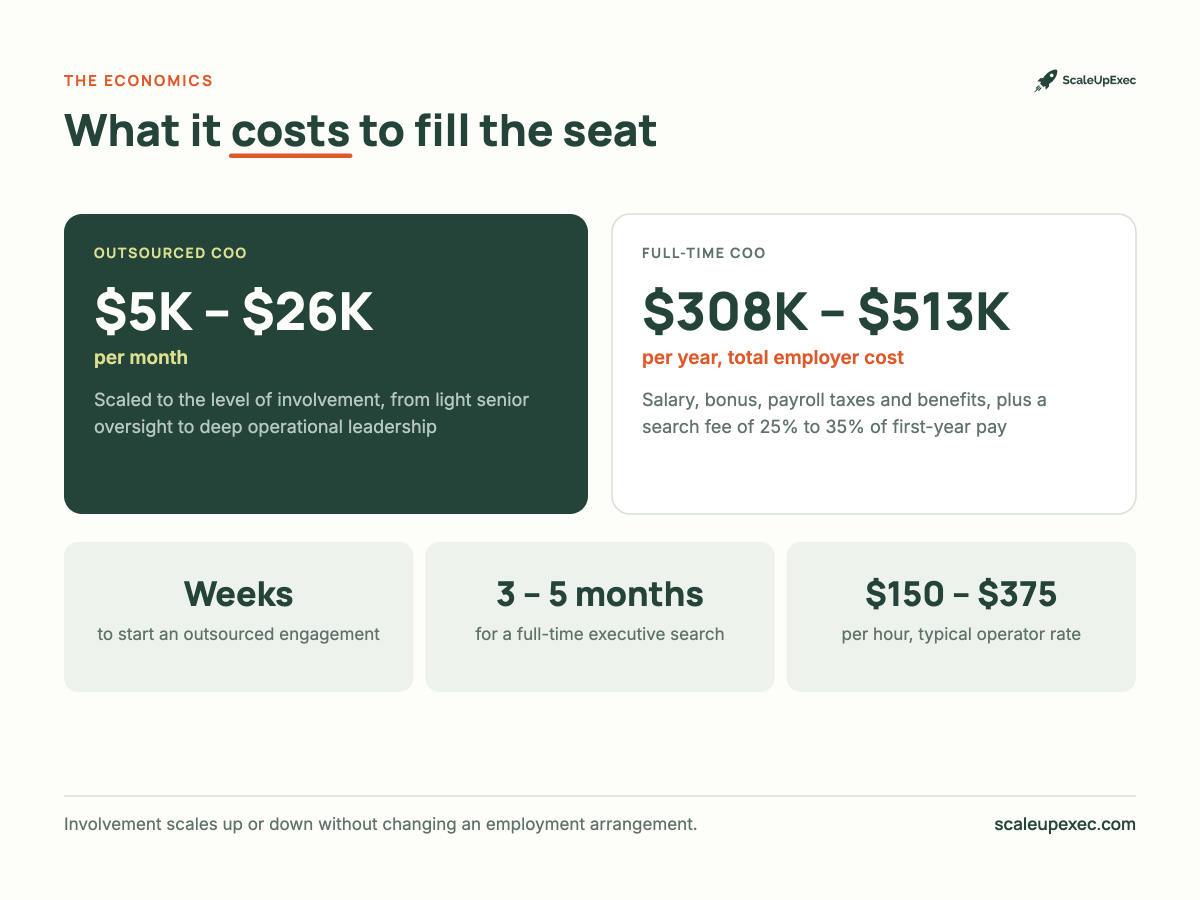
Outsourced COO services typically cost $5,000 to $26,000 per month depending on the level of involvement, with most operators charging between $150 and $375 per hour. The comparison against a full-time hire is where the model’s economics become clear.
Pricing scales with how much of an operator’s time the business needs. A lighter engagement focused on senior oversight and operating cadence sits at the lower end of the range. A deeper engagement, where the operator is heavily involved in day-to-day execution or leading a turnaround, sits at the upper end. The monthly retainer is set to match that level of involvement and adjusted as the business’s needs change.
| Option | Typical Cost | Notes |
| Outsourced COO | $5,000 to $26,000 per month | Scaled to the level of involvement the business needs, from light senior oversight to deep operational leadership |
| Full-time COO | $308,000 to $513,000 per year in total employer cost | Salary, bonus, payroll taxes, benefits, plus a search fee of typically 25% to 35% of first-year compensation |
Two further economics worth noting. A full-time executive search takes 3 to 5 months before anyone starts, while an outsourced engagement typically begins within weeks. And the outsourced model scales in both directions: involvement can increase during an intensive phase and reduce once systems are running, without the complications of changing an employment arrangement.
For the full pricing breakdown, see: Fractional COO Rates.
When Outsourced COO Services Make Sense
The model fits when the business has real operational complexity, the founder is carrying too much of it, and a full-time executive is not yet justified.
The signals that point to it:
| Signal | Why It Points Here |
| Growth has outpaced the systems supporting it | Revenue climbed but the processes underneath are the same improvisations from year one |
| The founder is the operational bottleneck | Decisions, escalations, and follow-through all route through one person |
| Execution is inconsistent despite a capable team | The gap is leadership and accountability structure, not talent |
| Departments are misaligned | Cross-functional problems need someone with authority across functions |
| A full-time COO is not affordable or not yet needed | The business needs the judgment, not full-time hours |
| Previous consulting produced reports but no change | The gap is execution ownership, which advice alone cannot fill |
If several of these describe your business, the model belongs on your shortlist.
When Outsourced COO Services Are Not the Answer
The model does not fit every situation, and knowing the mismatches in advance saves an expensive detour.
| Situation | Why It Does Not Fit | Better Option |
| You need a seat covered full-time for a defined period | Part-time ongoing is the wrong shape | Interim COO |
| You need task capacity, not leadership | An operator leads and decides; they are not extra hands | Operational hire or external team |
| The problem is one function, not the whole operation | A company-wide operator is overqualified for a contained problem | Functional hire, such as a VP of Operations |
| You are not willing to give the operator real decision authority | Without authority, any senior leader fails | Address readiness first |
| The business is very early and the issue is product-market fit | Operational leadership does not fix a product problem | Focus on customers and the offering |
| You mainly need a diagnosis before committing to anything | An ongoing engagement is premature | A consulting engagement first. See: Fractional COO or Operations Consultant |
The authority point is the one that determines success more than any other. An outsourced COO who has to route every decision back to the founder is an expensive advisor, not an operator.
How the Engagement Typically Works
Engagements follow a consistent arc: a diagnostic in the first month, prioritization and early wins by month two, substantive building through month six, and then transfer of ownership so the business runs without depending on the operator.
Contracts are typically rolling monthly retainers with a notice period, rather than fixed-length projects, and involvement can adjust as the business’s needs change. A well-run engagement should include a 90-day checkpoint with defined work products, so both sides can evaluate whether it is working against something concrete.
How to Choose a Provider
Evaluate providers on the caliber of their operators, the rigor of their vetting, how they match an operator to your business, and whether they own execution rather than just advising.
The quality range across providers is wide. Some work exclusively with operators who have scaled businesses to significant exits and led operations at major companies. Others function closer to staffing agencies, matching on availability. Both describe themselves the same way, which is why the evaluation questions matter more than the marketing.
The short version of what to probe: what have their operators specifically built or turned around, what percentage of applicants do they accept, how do they match beyond availability, and what happens if the fit is wrong at week six.
FAQs
What are outsourced COO services?
Outsourced COO services provide a business with an experienced operations executive who works part-time on an ongoing basis. The operator joins the leadership team, builds operating systems, manages execution and accountability, and is accountable for operational outcomes, all without the cost of a full-time hire.
Is an outsourced COO the same as a fractional COO?
Yes. The two terms describe the same service, and providers use them interchangeably. “Fractional” has become the more common label, but the engagement underneath, a senior operator working part-time and ongoing with ownership of outcomes, is identical.
How much do outsourced COO services cost?
Typically $5,000 to $26,000 per month depending on the level of involvement, with most operators charging between $150 and $375 per hour. For comparison, a full-time COO costs $308,000 to $513,000 per year in total employer cost, plus a search fee of 25% to 35% of first-year compensation.
What does an outsourced COO actually do?
They build and run the company’s operating rhythm, own execution of priorities, manage function heads and team accountability, install reporting and KPI systems, and absorb the operational decisions currently routing through the founder. Specific scope is defined at the start of each engagement.
When should a company use outsourced COO services?
When growth has outpaced the systems supporting it, the founder has become the operational bottleneck, execution is inconsistent despite a capable team, or the business needs senior operational judgment without being able to justify a full-time executive.
What is the difference between an outsourced COO and an outsourced operations team?
An outsourced COO is one named senior operator who joins your leadership team and owns outcomes. An outsourced operations team is an external group handling defined operational tasks. The first provides leadership, the second provides capacity. Ask any provider which one they are actually offering.
How quickly can an outsourced COO start?
Typically within weeks, compared with 3 to 5 months for a full-time executive search plus several more months of ramp. Faster time-to-impact is one of the model’s main advantages for a business under operational pressure.
Can outsourced COO services scale up or down?
Yes. Engagements typically run on rolling monthly terms with adjustable involvement, so a business can start at a lighter level, increase during an intensive phase, and reduce once systems are built and running, without the complications of changing an employment arrangement.
Considering Outsourced COO Services?
The label matters less than the substance: a named senior operator, embedded in your leadership team, with real authority and accountability for outcomes.
At ScaleUpExec, that is exactly what we provide. We exclusively work with top-tier fractional COOs, operators who have scaled businesses to 8- and 9-figure exits, led operations at Fortune 500 companies, or turned around 20+ businesses. They join founder-led businesses part-time to take ownership of both strategy and execution, build the operating systems, and get the founder out of the daily bottleneck. Our clients consistently see ROIs of 5-10x or more on their investment.
If your situation calls for something different, an interim executive, a functional hire, or a diagnostic first, we will say so.
Book a Free 30-Minute Strategy Call to talk through what is happening in your business and whether this model fits.
Book a Free 30-Minute Strategy Call
No pressure. No obligation.
ScaleUpExec is a specialist in the fractional COO space, with 30+ engagements and over a dozen top-tier COOs on the team, each extensively vetted. That focus is reflected in our track record of 0 client churn.
Prefer to explore first? See what our clients say or learn about Fractional COO Rates.